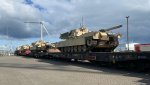
Military train logistics in Europe are a nightmare.


At this moment, military transport is at the bottom of the logistics priority list (crazy but true). Cargo and passengers are first, so those military trains have to wait for a hole in the extremely busy European rail traffic. With a mix of cargo and passenger trains, think the traffic mess on the Chicago I-290 and I-294/I-88 interchange but then Europe-wide and non-stop. With all the paperwork from crossing different countries on top, it can take a month to get military material from the Ports of Rotterdam, Antwerp or Vlissingen to the Eastern borders of the EU and to Ukraine.


That is going to change now hopefully on a European scale. As of later in 2026 in the Netherlands, military trains will have top priority. The idea is that there will be about 6,000 miles of "military-standard" railroad corridors throughout Europe.
To clarify, the EU has approximately 126,000 miles of railroad
routes. Most of these routes are double track or even triple track but these are still counted as one route. The USA as almost 140,000 miles of railroad but with a surface about 2.3 x the EU. Most of the US railroad routes are single-track, in contrast to the EU situation.


That will cause delays for passengers and at railroad crossings. The average waiting time for an automated railroad crossing is about 45 seconds. With a 2,300 feet long military transport, that waiting time will go well over 6 minutes, even longer if the crossing is in urban areas or special slow locations.


Another problem is that, with land at a max premium, the standard double-track layout at stretches does not have enough room for two trains when transporting oversized MVs. That means that oncoming rail traffic has to be halted as well to let the MV train pass.
Anyway, I thought the Dutch news articles had some nice pics that could be shared here.