• Steel Soldiers now has a few new forums, read more about it at: New Munitions Forums!

  • Microsoft MSN, Live, Hotmail, Outlook email users may not be receiving emails. We are working to resolve this issue. Please add support@steelsoldiers.com to your trusted contacts.

Long post (questions, tips) about turboing a 6.2 with 6.5 parts

Subourbon82

New member
15
1
3
Location
Quebec canada
Boost master is the threaded rod that acts as a wastegate, correct? Rather than relying on vacuum to open the waste gate. Which i bieve is what I've got onnthe turbo I purchased. What are the pros n cons of that?
 

TechnoWeenie

Well-known member
Steel Soldiers Supporter
1,798
1,998
113
Location
Nova Laboratories, WA
From a conversation that I had with an engineer ref the 6.2 vs the 6.5. Anything more than 6 PSI boost on the 6.2 is basically asking for a problem. 3 PSI is the safest boost he'd suggest, which would net about 15% increase in power and usually a bump in MPG if you can keep your foot out of it 3 PSI is a noticeable increase but 6-10 PSI will push you to 200HP over the base 130HP and all but guarantee a bottom end failure.. Banks had a turbo kit for the 6.2 and it was 7-10 PSI.
 

Subourbon82

New member
15
1
3
Location
Quebec canada
Thats interesting coz, i ve done a fair bottom research on gm squarebody forums, diesel place. Almost all truck and or diesel forums, and while there is a split between do you'll be fine, vs don't do it you'll blow it up,
Here's what I've noticed

Stock: Just oil feed & drain, manifolds intake n exhaust) and turning up fuel. Still head bolts nothing else change. 6 psi and you're fine. Some claim more but most I've seen in reading forums is 6.

Arp head studs and of course new head gaskets: claims of 10 to 12 comfortably.

More than that then guys are talking intercooler, and that coolant passage at rear of block with those two flange, passenger side blanked and old style 6.2 (like mine) have the glow plig controller screwed into to coolant passage in block, well as cross over between that. Allegedly, 15 psi n more.

This is a general consensus.
I do appreciate to earlier answers to this post, sharecropper saying a lot of guys doing this and then send it uo to 14 psi boost but never really hear from them again, did they cook the engine? Did lower end go for a sh*t?
3 psi is pretty small, I'm not arguing your point. I'm wide open to all suggestions. And I know 6.2 isn't meant for power, but 3 psi is crazy low.

Another thing I came across that not many users on any foru.s mention is, engine girdle. To protect to lower end. Some say don't bother, waste of time etc etc etc... the one specific to 6.2 n 6.5 is on the pricy side. But it does come with the studs. However, scamazon dpes have one for small block chevy for a lot cheaper.

Aren't the 6.2 n 6.5 just a diesel powered sbc? As in, in the 80s during fuel crisis gm was in a rush to push out an economical diesel and they basically took the SBC and gave it IDI heads, an injection pump and called it a day, or am I in left field? (Speakingnof baseball references, world series is interesting this year BTW, go Jay's!)


So, hypothetical build here (and expensive)
1. Fluidampr harmonic balancer.
2. Arp head studs and a thicker new gasket, installed dry, some guys talk about copper spray, but last I checked, head gaskets go on dry.
3. Machined heads with a bit taken off to lower compression ratios a bit
4. Engine girdle with studs,
5.Finally say, 6 to 8 psi boost.

Thats basically all the mods you can possibly do to strengthen a 6 2 (i skipped the 6.5 pistons swap coz I don't wanna go there) again, hypothetical build here.

 

Barrman

Well-known member
5,544
2,378
113
Location
Giddings, Texas
No, the 6.2/6.5 engines are not based on a small block Chevy. Detroit Diesel built a clean sheet design to fit in the same space as a SBC, have the same power as a base 305 gas 2 barrel engine and get twice the mpg. It does that perfectly. Detroit Diesel was owned by GM at the time.

Buick and Oldsmobile adapted diesel engines with some common parts as their gas engines. Some GM trucks ended up with those engines in them before the 6.2 came along and then along side the 6.2 as an option. GM basically had a mess trying to go from each division doing everything separately to sharing among them all.
 

Sharecropper

Well-known member
Steel Soldiers Supporter
1,987
1,356
113
Location
Paris KY
No, the 6.2/6.5 engines are not based on a small block Chevy. Detroit Diesel built a clean sheet design to fit in the same space as a SBC, have the same power as a base 305 gas 2 barrel engine and get twice the mpg. It does that perfectly. Detroit Diesel was owned by GM at the time.

Buick and Oldsmobile adapted diesel engines with some common parts as their gas engines. Some GM trucks ended up with those engines in them before the 6.2 came along and then along side the 6.2 as an option. GM basically had a mess trying to go from each division doing everything separately to sharing among them all.
Barrman, in my opinion, there's no reason for you to continue participating in this thread. It is quite obvious that the OP is not going to listen to any advice, but instead it seems that he is trying to find SS members who will agree with him so he can justify destroying a perfectly good 6.2. He states that he has read on "other forums" this or that, but in reality, there is no greater authority on the 6.2 than right here on SS. Why? Because every person on this forum (1,000's) has a 6.2 and the vast majority have tried every conceivable way to increase power from the engine. Me included. I have owned & modified 6.2's ever since 1985 and feel that I know as well as anyone what can and cannot be done to the powerplant. My current M1028 OEM 6.2 had 12,338 original miles when I obtained it in 2010. The first thing I did was install a Fluidampr, then I installed an open-plane intake and rigged-up a fresh-air supply to the breather. I sent the IP to Huckstorf and had it completely rebuilt and set the fuel at 175, and installed marine injectors. All this cost approximately $2,000. It runs like a scaled dog and has only 15,178 current miles. Never did I consider adding a turbo. The engine just was not designed by GM to handle the added pressure & torque at the bottom end, nor was the cooling system designed to remove the additional heat produced by a turbo. I'm no expert and don't pretend to be one, but I know what I know. At 75 I am not smarter than the next guy, but I am wiser from age and experience. So I suggest that you unsubscribe from this thread, as I have, and let the OP do as he wishes. And I apologize in advance if this post offends anyone.

Respectfully,
Mike Gresham, Paris, KY
 

patracy

Administrator
Staff member
Administrator
14,808
5,503
113
Location
Buchanan, GA
Boost master is the threaded rod that acts as a wastegate, correct? Rather than relying on vacuum to open the waste gate. Which i bieve is what I've got onnthe turbo I purchased. What are the pros n cons of that?

Threaded rod with a spring. It uses backpressure to actuate instead of boost pressure. A normal wastegate actuator uses a diaphragm and spring to control the wastegate opening. The problem or what it does differently is running off backpressure instead. The traditional actuator begins to open sooner since pressure has increased on the diaphragm. Think of it as holding the wastegate closed until you truly hit the desired pressure. The other way, you'd eventually get to that desired pressure, but you'd begin opening that wastegate early and losing some spooling you otherwise could have used.

The cummins 12v guys used to also do a trick where they'd replace the inlet elbow to the actuator with a elbow that had a small (Like .090 or something) hole drilled into it. It'd bleed off pressure right before the diaphram to effectively do the same thing. (delay the gate opening)

The pros: easier to adjust. No diaphram to fail.

Cons: you could overtorque it and effectively lock the wastegate.
 

patracy

Administrator
Staff member
Administrator
14,808
5,503
113
Location
Buchanan, GA
From a conversation that I had with an engineer ref the 6.2 vs the 6.5. Anything more than 6 PSI boost on the 6.2 is basically asking for a problem. 3 PSI is the safest boost he'd suggest, which would net about 15% increase in power and usually a bump in MPG if you can keep your foot out of it 3 PSI is a noticeable increase but 6-10 PSI will push you to 200HP over the base 130HP and all but guarantee a bottom end failure.. Banks had a turbo kit for the 6.2 and it was 7-10 PSI.
3 psi honestly would be hard to notice.

GM actually sold Banks' turbo setup in the 80's as a option. The basis of the design was adapted to the 6.5TD by GM. The stock 6.5's ran 7psi from the factory. Stand on one in a manual truck and it'd spool to 10psi or more and then decline with RPM.

More info, the 6.2 had a 21.3:1 CR. The late 6.5's dropped down to a 20.3:1.

Marine engines had 18:1. If you want to put 12+ psi to a 6.2/6.5, a marine engine with the lower CR or a rebuild with mahle 18:1's would make for a 6.2/6.5 that would hold an atomsphere (14psi) or more boost till the cows come home.
 

Subourbon82

New member
15
1
3
Location
Quebec canada
Barrman, in my opinion, there's no reason for you to continue participating in this thread. It is quite obvious that the OP is not going to listen to any advice, but instead it seems that he is trying to find SS members who will agree with him so he can justify destroying a perfectly good 6.2. He states that he has read on "other forums" this or that, but in reality, there is no greater authority on the 6.2 than right here on SS. Why? Because every person on this forum (1,000's) has a 6.2 and the vast majority have tried every conceivable way to increase power from the engine. Me included. I have owned & modified 6.2's ever since 1985 and feel that I know as well as anyone what can and cannot be done to the powerplant. My current M1028 OEM 6.2 had 12,338 original miles when I obtained it in 2010. The first thing I did was install a Fluidampr, then I installed an open-plane intake and rigged-up a fresh-air supply to the breather. I sent the IP to Huckstorf and had it completely rebuilt and set the fuel at 175, and installed marine injectors. All this cost approximately $2,000. It runs like a scaled dog and has only 15,178 current miles. Never did I consider adding a turbo. The engine just was not designed by GM to handle the added pressure & torque at the bottom end, nor was the cooling system designed to remove the additional heat produced by a turbo. I'm no expert and don't pretend to be one, but I know what I know. At 75 I am not smarter than the next guy, but I am wiser from age and experience. So I suggest that you unsubscribe from this thread, as I have, and let the OP do as he wishes. And I apologize in advance if this post offends anyone.

Respectfully,
Mike Gresham, Paris, KY
Appreciate the thoughts man.
I disagree with ruining the engine. I believe if done right and within reason, a turbo to any engine is an upgrade. Emphasis on "if done right and within reason."

Apologies if you feel you aren't being listened to. I think it is a matter of opinion. There's a ton of scenarios where a turbos worked, and a ton where it hasn't. I am trying to find a distinction where it has vs hasn't. And follow the steps
 

Subourbon82

New member
15
1
3
Location
Quebec canada
Appreciate the thoughts man.
I disagree with ruining the engine. I believe if done right and within reason, a turbo to any engine is an upgrade. Emphasis on "if done right and within reason."

Apologies if you feel you aren't being listened to. I think it is a matter of opinion. There's a ton of scenarios where a turbos worked, and a ton where it hasn't. I am trying to find a distinction where it has vs hasn't. And follow the steps
Whoops, clipped the post reply button too soon. Sorry.
What i was saying was follow the steps and do it in such a way that can be done in a symbiotic way that i get boost, and the engine stays together. I have been collecting parts. But I haven't gone past the point of no return yet, which is dropping an insane amount of money on aftermarket parts. I got the manifolds turbos and turbo feed and drain lines for cheap. The expensive bits are the girdle, harmonic balancer, arp head studs and machining heads...

Anyways, I appreciate all answers positive and the ones deemed "negative" of course, this is a conversation, not a "my say not your say" scenario.
I've never done a turbo, you have.

Cheers,
Eric

I'm not trying to find members to agree with me and ignore naysayers. I understand
 

patracy

Administrator
Staff member
Administrator
14,808
5,503
113
Location
Buchanan, GA
FWIW, I will say perhaps I'm not a fair case study. I've added turbos to 6.2's, VW 1.6 diesels, even a NHC-250. I'm in no way telling people to run out and add one. I'm just stating that adding a turbo to a NA diesel is not an instant death sentence if operated accordingly. All three of the NA engines I've turbo'ed all come with hurdles/negatives that otherwise impact their longevity. The 6.2/6.5 with it's high CR and bottom end concerns. The VW 1.6's had turbo engines, but those engines had oil squirters. Mine did not. Same with the NHC-250.

I like gauges. I even have a Edge CTS3 on my Ecodiesel. That engine does have tuning that *could* destroy itself if ran hard in it's highest setting. But on the stock tune (which is what I typically run it in) the gauge is completely unnecessary due to the limitations. That same concept applies to older mechanical diesels. When boost and fueling are tinkered with, you the driver needs to become the safeguard to the engine. Even then, the engines in the CUCV and my HMMWV are only turned up enough to keep it within that 10psi tops range. I STILL have gauges in both of them, and still drive by those gauges. I actually use pyro to gauge fuel usage on my Ecodiesel to ensure I see 25+ mpg.

I guess I'm off on a ramble at this point so I'll get off the soapbox.
 

Ilikemtb999

Active member
703
47
28
Location
Denver, CO
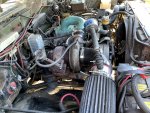
I've had my m1009 turbo'd for many years. Started with a gm4 turbo and moved to an HX35 off of a 12v a few years ago. It typically makes 15+ psi of boost at higher rpm's (it actually goes past that but my gauge only goes to 15). My egt's see 850ish pre turbo. I'm not sure I've ever seen it over 900 degrees.

My setup is 6.5 manifold with two gaskets, 2.5 crossover cut up a bit and welded to the stock driver flange, 3" downpipe snaked thru between frame and engine and then 4" exhaust to a big pass thru muffler. I turned the fuel screw maybe 1/8 turn from stock (i'm at 6K feet elevation though). I've got a 6.5 lower manifold under an aftermarket upper.

Eventually I’ll get around to boxing in my air filter.
 

Attachments

Last edited:
Top